
One Hour, One Million: What Piper Rockelle’s OnlyFans Debut Reveals About Los Angeles’ Creator Economy
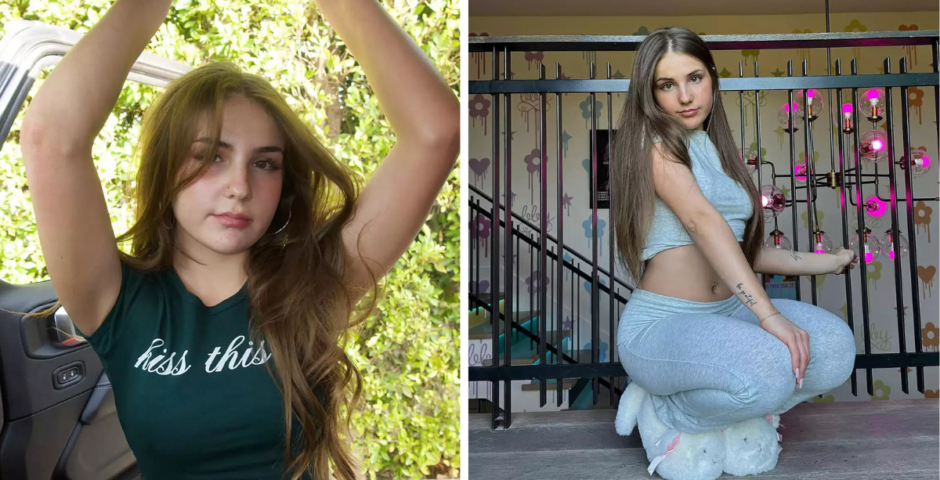
Piper Rockelle’s OnlyFans debut was not simply a personal milestone; it was a cultural flashpoint that underscored how Los Angeles’ creator economy rewards scale, speed, and years of accumulated attention. Within 60 minutes of launching her account on January 1, 2026, Rockelle earned more than $1 million, posting a screenshot that showed a gross total of $1,259,052.79 from the day’s earnings.
According to the dashboard she shared, $896,000 came from subscriptions, $299,711 from message revenue, and $63,342 from tips, bringing her net take-home total to $1,007,242.23. The numbers moved faster than the discourse could keep up.
“We broke the record!!! $1,000,000 in less than an hour,” Rockelle wrote on X. “You guys are the best thank you for changing my life.”
The response was immediate and layered. Sophie Rain, a fellow Bop House creator and Rockelle’s friend, replied with humor and candor: “damn I got competition now.” Across social media, reactions ranged from celebratory to cuttingly self-aware. “My degree just looked at this post and started crying in the corner,” one user wrote. Another added, “I opened my link at the same time and I owe money.”
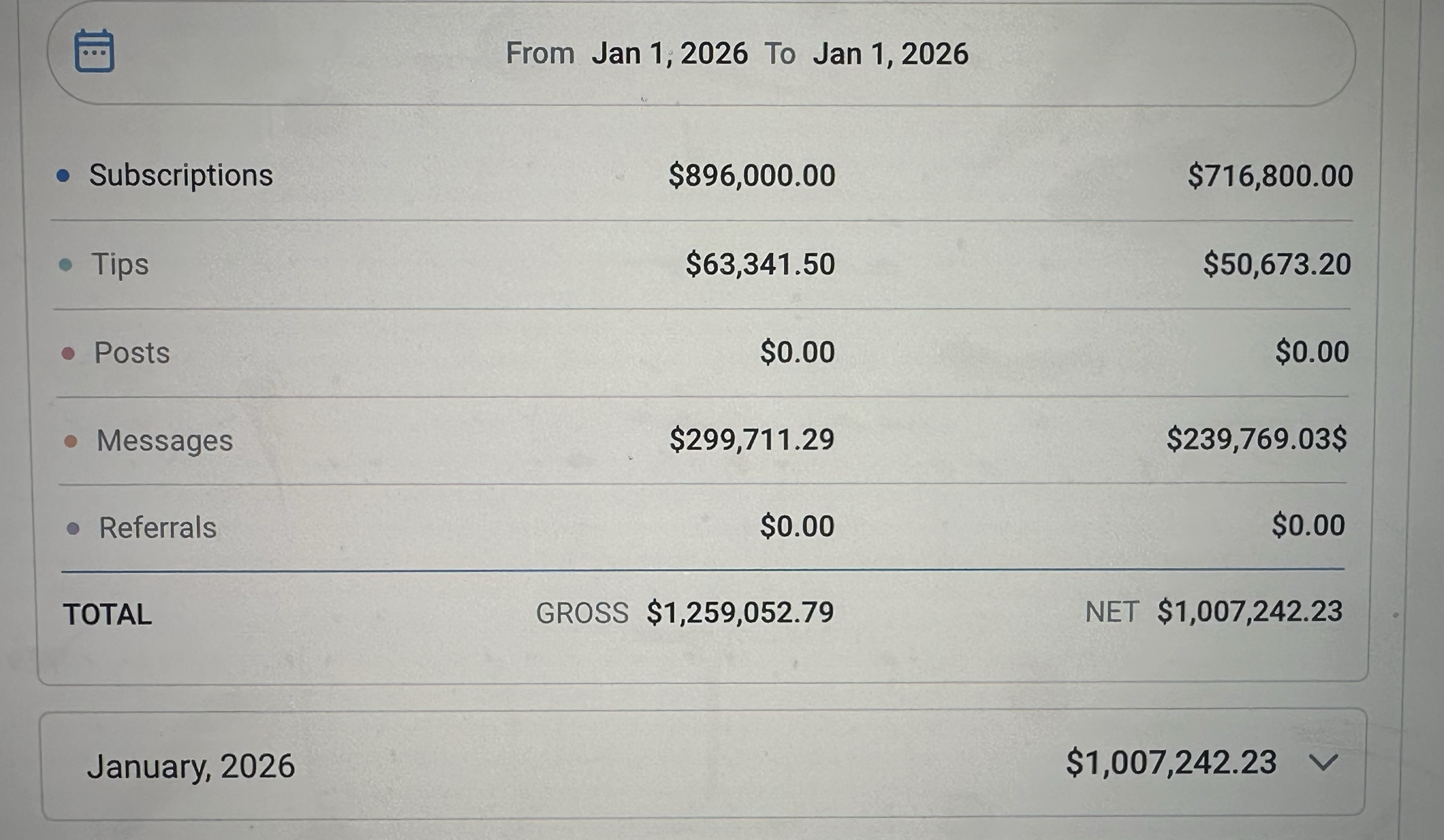
Via OnlyFans
But as the screenshots circulated, so did unease. Critics focused less on the legality of Rockelle’s decision and more on the cultural context surrounding it—particularly the transition from child creator to adult platform at scale. “Turned 18 months ago, opened [the account] two hours ago. Already at $1 million,” one post read. “The problem isn’t the women. The problem is the men buying.” Another user wrote more bluntly, “Kind of disturbing people follow child YouTubers and pray for the day they do OF.”
The breakdown of her earnings intensified the conversation. “299k from messages is crazy,” one user commented, highlighting how direct, personalized engagement has become one of the most lucrative features of the platform—and a defining mechanism of modern creator monetization.
Still, praise was just as loud. “I’m so happy for u girl,” one fan wrote. “I know I’ll get to this level someday. I can feel it.” In Los Angeles’ creator culture, ambition is contagious, and Rockelle’s debut read to supporters as proof that audience-building, when done early and consistently, can translate into unprecedented financial leverage.

Rockelle addressed the criticism directly, framing her decision through the language of autonomy and self-determination that defines much of the city’s influencer economy. “I waited until I was legal, and I made that decision for myself. This wasn’t something I was pressured into. It was about taking control of my own content, my own body, and my own income. People can judge all they want, but I did this on my own terms, and I’m proud of that. I know who I am, and I know what I’m building,” she said in a statement.
She also acknowledged the discomfort many feel watching a creator they first encountered as a child enter an adult space so publicly.
“Of course, I saw the comments. People are saying I was groomed or that the subscribers are creeps. Look, I get it. I was a kid on YouTube, and now I’m an adult making adult choices. That shift is uncomfortable for some people. But I’ve grown up in front of the world. I’m not asking for approval. I’m asking for people to respect that I’m not 13 anymore.”
In Los Angeles, where creators are often raised alongside their audiences, that shift is rarely quiet. Rockelle’s one-hour milestone crystallized years of visibility into a single, explosive moment—one that revealed both the power and the discomfort embedded in the city’s content machine. Her debut wasn’t just about earnings; it was about how quickly attention, familiarity, and controversy can converge into capital in a culture built to monetize growth in real time.
